|
Thank you, from the BaitShop Boyz! |
Quick Tip for the Week |
Post Reply 
|
Page 123 4> |
| Author | |
TasunkaWitko 
Administrator 

aka The Gipper Joined: 10 June 2003 Location: Chinook Montana Status: Offline Points: 14753 |
 Post Options Post Options
 Thanks(0) Thanks(0)
 Quote Reply Quote Reply
 Topic: Quick Tip for the Week Topic: Quick Tip for the WeekPosted: 05 October 2005 at 06:48 |
|
21 sep 05
Jack O’Connor considered a trophy whitetail buck to be the most difficult of American big game animals to bag. They do not grow those huge sets of antlers by being foolish! More than noise or scent, I would say that the biggest danger of spooking a wary whitetail is that he will see your movement. Walk softly, stay upwind of the area you want to hunt, and stay out of sight. Work the edges of tree- or brush-lines and keep low when possible. Many times, you can walk right by one while stalking or still-hunting and not even know it; other times, they will detect you abscond with impressive stealth. You will probably enter an area never knowing that they had just left. If you are seen, a whitetail might try to wait it out while you pass. If you stop for a moment every 15 or 20 yards and carefully look around, you might notice or jump a trophy. For more recipes, as well as excellent outdoors-related discussion, be sure to visit www.baitshopboyz.com!~~ |
|
|
TasunkaWitko - Chinook, Montana
 Helfen, Wehren, Heilen Die Wahrheit wird euch frei machen |
|
 |
|
|
TasunkaWitko
Administrator
aka The Gipper Joined: 10 June 2003 Location: Chinook Montana Status: Offline Points: 14753 |
Post Options
Thanks(0)
Quote Reply
Posted: 05 October 2005 at 06:49 |
|
Quick Tip for the Week
Take a kid fishing, hunting, camping or even out for a day of shooting. More and more, the outdoors sports are becoming a thing of memory; something all of us remember fondly, but never seem to have enough time for these days. If you know of a youth who might like to do these things, but doesn’t have much opportunity due to the home situation, offer to take him or her out when you take your own kids. You might spark an interest or set an example that will last a lifetime. When taking a youngster afield, don’t expect to get an opportunity to chase a trophy for yourself. Make the day about the kid, and chase that 6-pound fish or trophy bull elk on another day. For more recipes, as well as excellent outdoors-related discussion, be sure to visit www.baitshopboyz.com! Edited by TasunkaWitko |
|
|
TasunkaWitko - Chinook, Montana
Helfen, Wehren, Heilen Die Wahrheit wird euch frei machen |
|
|
|
|
TasunkaWitko
Administrator
aka The Gipper Joined: 10 June 2003 Location: Chinook Montana Status: Offline Points: 14753 |
Post Options
Thanks(0)
Quote Reply
Posted: 05 October 2005 at 06:50 |
|
5 oct 05
If you have a rifle that isn’t shooting accurately, don’t be too quick to sell it! Chances are that you can do some very simple and inexpensive things to correct the problem. Regarding the rifle itself, you have several options. Open up the barrel channel a bit in order to free-float the barrel. You can also glass bed the barrel very easily, or even install pillars to ensure metal-to- metal contact. Any of these steps will help to stabilize the relationship between your rifle barrel and your sock. Another simple option would be to have the muzzle crowned in order to ensure that the gasses are exiting in a way that won’t de-stabilize the bullet. If you handload, you have even more options. You can try different components; brass, primers, powders or bullets. You can also vary your powder charges or the seating depth of your bullet. Sometimes even a tenth of a grain of powder or a thousandth of an inch in the seating depth will shrink groups dramatically. Almost any rifle should be capable of printing a one- inch group at a hundred yards. In order to achieve this goal, it is usually a matter of tuning your rifle and ammunition; however, the final accuracy of any rifle will always lie with the shooter. For more recipes, as well as excellent outdoors- related discussion, be sure to visit www.baitshopboyz.com! |
|
|
TasunkaWitko - Chinook, Montana
Helfen, Wehren, Heilen Die Wahrheit wird euch frei machen |
|
|
|
|
TasunkaWitko
Administrator
aka The Gipper Joined: 10 June 2003 Location: Chinook Montana Status: Offline Points: 14753 |
Post Options
Thanks(0)
Quote Reply
Posted: 05 October 2005 at 08:15 |
|
12 oct 05
Two of the simplest rigs for trout fishing are probably also the most effective. They can be used by young or old alike, and do not rely on so-phisticated gear or fancy knot-tying. For stream fishing, use one or two split-shot, just enough to keep the hook and bait cruis-ing on the bottom, then tie on an appropriately-sized hook 6-12 inches above the split-shot. I prefer the Trilene knot, which is a close cousin to the standard clinch knot; however, any strong knot will work. This rig, while simple, is incredibly versatile. You can fish fast or slow streams with worm, salmon egg, spawn sack, scud, grasshopper or any other bait available. The length of line between the split-shot and the hook will vary according to the stream conditions. With a little practice, you will be able to judge what works best. For lake fishing, thread on an egg sinker that is only heavy enough for good casting. Tie a small barrel swivel (the smaller the better, as long as it stops the egg sinker from rid-ing the line) to the end of the line. A barrel swivel is simply a regular snap swivel without the snap. To the other end of the swivel, attach a leader of line (once again, you can vary the length; anywhere from 6-12 inches is probably good) with a hook at the end. This hook can then be baited as you please. To float bait off the bottom, run a miniature marshmallow sideways up the hook to the eye. Depending on the weight of the bait, it will float as high as the leader is long. The beauty of this rig is that a wary trout can nip and snatch at the bait, but the line will slip through the egg sinker. This means that there will be very little, if any resistance which could spook the fish. Both of these rigs, as you can see, are very easy and very versatile. Since adopting these rigs, I have caught many more fish than using any other method. They are my two "go-to" rigs for trout fishing, and can also be used for other fish; just use bigger or smaller equipment, depending on the fish you are after and the water you are fishing. For trout fish-ing, always use the smallest equipment (line, sinker hook, etc.) that you can get away with, because trout are ex-tremely wary. For more recipes, as well as excellent out-doors- related discussion, be sure to visit www.baitshopboyz.com! |
|
|
TasunkaWitko - Chinook, Montana
Helfen, Wehren, Heilen Die Wahrheit wird euch frei machen |
|
|
|
|
TasunkaWitko
Administrator
aka The Gipper Joined: 10 June 2003 Location: Chinook Montana Status: Offline Points: 14753 |
Post Options
Thanks(0)
Quote Reply
Posted: 14 October 2005 at 04:33 |
|
19 oct 2005
Anyone with questions or tips regarding hunting, shooting or fishing is encouraged to submit them by mail to The Journal in care of Ronald Fischer; they can also be emailed to bcj_fischer@yahoo.com. Selected tips or answers to selected questions will be posted when possible. When it comes to truly enjoying your deer or antelope at the table, first and most important is to do the butchering yourself. It is not that difficult and no way mysterious. Once you get started removing the meat from the bone it is all self-explanatory. For what it is worth, I have butchered all my own game except one deer, and the main thing I have learned is to get everything off of the meat that isn't meat, because careful trimming will ensure the best tasting meal. This includes fat, membrane, silverskin, bone, you name it. Trim it off carefully with a very sharp fillet knife, you will be left with a nice roast, which you can package or cut into steaks, butterfly steaks or cubes. Another thing, at least in this cool, dry climate, is to leave the animal to hang a few days. This will age the meat and make it very tasty, using the same process that the big beef places use for prime rib and such. Here in north-central Montana, considering the weather during hunting season, I can let a deer hang for a week easily; even two weeks, if it gets cold during the night and the deer is hung in a shady place such as in a garage or shed. Then I can skin and butcher it over a weekend. Antelope, on the other hand, should probably not be hung longer than 3-4 days because of the warmer temperatures during the day and the fact that antelope meat is much more delicate than deer. If you have to skin it immediately because of the climate or cannot hang it for some reason, you can skin it, then cut out the loins and tenderloins and remove the front quarters, then saw the hindquarters into two quarters. Place each quarter into a trash bag (unscented) and the loins and backstraps into another one and store them in the fridge for at least 3 days, but no more than a week. There is not much steak on the shoulder. Trying to make steak of any cut other than the tenderloin, loin or hindquarter sets you up for disappointment. Having said that, the shoulder is excellent meat and after being boned should be cubed up for stew meat, burger or sausage if you like. The loin and tenderloin cuts speak for themselves. Simply bone along the backbone ridge and off of the ribs. The best way of butchering the hindquarters is to first remove them one at a time from the pelvic bone. It will take some experience to remove the quarters cleanly. But don't worry about your first efforts, whatever you botch up makes excellent stew meat to add to your shoulder. Once you have the removed quarters, examine them. There are lines to follow for undoing the muscle groups. Use the tip of a fillet knife and slit along these lines and pull with your other hand to separate the muscles from one another along the vellum (silverskin) folds. The entire quarter will come apart this way. Some of the muscles will be flat and diagonal, some will be round and straight, but all will be separated from each other by the gray vellum that allows the muscles to slide against each other as the animal moves. Use this vellum as your road map to disassemble the quarter. Once you have separated the major groups, trim every bit of fat, membrane and silverskin off and slice the steaks perpendicular to (across) the grain. As for the ribcage and neck, there are many options. You can trim quite a bit of good meat off for jerky or cut the ribs into equal sections, then saw the sections in half and wrap them for barbecued ribs. Cut the neck off and wrap it whole as a roast. If none of these options works for you, you can take the whole thing in to be made into burger or sausage. When it comes to packaging venison, I have become a very big believer in using home vacuum sealers. They are inexpensive, convenient and work very well to keep meat fresh. If you do not have one, there is another easy option that works just as well. Portion out your meat as you wish (I do a pound at a time), then stuff the meat into a quart-sized freezer bag. Gently squeeze out all the air you can, then fold the bag in half, and seal, taking care to keep air from entering. Freeze each bag separately (not stacked together) on a flat surface in the freezer. The reason for this is because the meat will freeze faster and be less likely to develop ice crystals, which can affect the texture and flavor. If you are packaging more than a pound of meat, folding the bag over may not be necessary, and you can freeze if flat. Once frozen, the bags can be wrapped in paper for extra protection and stacked in the freezer. Be sure to label the bag with the species, the date, the weight or number of portions, and any other information you feel to be pertinent. If you have a dog, it will love you for keeping the scraps, portioning them into dog-sized meals, freezing them in plastic bags and wrapping the bags in paper. I label these packages "DOG;" The kids think it is hilarious and the neighbors wonder.... For more tips, as well as excellent outdoors-related discussion, be sure to visit www.baitshopboyz.com! |
|
|
TasunkaWitko - Chinook, Montana
Helfen, Wehren, Heilen Die Wahrheit wird euch frei machen |
|
|
|
|
TasunkaWitko
Administrator
aka The Gipper Joined: 10 June 2003 Location: Chinook Montana Status: Offline Points: 14753 |
Post Options
Thanks(0)
Quote Reply
Posted: 20 October 2005 at 05:10 |
|
bumped to
2 nov 05 Quick Tip For The Week Anyone with questions or tips regarding hunting, shooting or fishing is encouraged to submit them by mail to The Journal in care of Ronald Fischer; they can also be emailed to bcj_fischer@yahoo.com. Selected tips or answers to selected questions will be posted when possible. When hunting deer, do not overlook any patch of brush, no matter how small or low to the ground it seems! One of the biggest whitetail bucks I have ever seen sprang up from a patch which I would have thought too small and to short to cover a gopher. A few years ago, I saw someone shoot a good-sized muley buck that actually crawled (CRAWLED!) Through a very expansive patch of brush that was only as high as my knees, trying to get away in the last seconds before the lung shot killed it. We literally had to look for it and I don't mind admitting that we would have been looking for quite a while except for the fact that I heard one leg scraping against the brush (less than knee-high!) As it literally exhaled its last breath. Tracking would have been difficult because the brush was not crushed, and the blood fell to the ground to be canopied by the brush. From what I could tell, the buck went totally unseen from the spot where it dropped 75 yards to the spot where it gave up the ghost, and once it dropped I had absolutely no way of knowing which direction it went. People who has been hunting a lot longer than I have and who have tracked deer for miles just for the challenge of it, could not find it. The only way I found it was by luck! Of course, we would have found it eventually, but it would have taken a while. The moral of the story is that these animals can hide, and are good at it. They will get down on their bellies and shinny around like snakes. I didn't believe it either…until I saw it! Don't overlook any patch of brush, when stalking or tracking, because they can be anywhere! For more tips, as well as excellent outdoors-related discussion, be sure to visit www.baitshopboyz.com! Edited by TasunkaWitko |
|
|
TasunkaWitko - Chinook, Montana
Helfen, Wehren, Heilen Die Wahrheit wird euch frei machen |
|
|
|
|
TasunkaWitko
Administrator
aka The Gipper Joined: 10 June 2003 Location: Chinook Montana Status: Offline Points: 14753 |
Post Options
Thanks(0)
Quote Reply
Posted: 02 November 2005 at 07:05 |
|
9 nov 05
-------------- Quick Tip For The Week Anyone with questions or tips regarding hunting, shooting or fishing is encouraged to submit them by mail to The Journal in care of Ronald Fischer; they can also be emailed to bcj_fischer@yahoo.com. Selected tips or answers to selected questions will be posted when possible. As per Mr. Jack O'Connor, here are some "rules" for long-range hunting. I believe that they can be agreed upon by most anyone who does much hunting. • A long-range shot should never be taken if there is a reasonable chance of getting closer. • A long-range shot should never be taken if the rifleman feels doubtful of his ability to make a good, solid, well-placed hit. • A long-range shot should never be taken if the hunter cannot get into a solid position - prone with a sling, from a rest, etc. • A long-range shot should never be taken at any dangerous animal - a brown, grizzly or polar bear, a lion, a tiger, a leopard, a cape buffalo. • A long-range shot should never be taken at an unwounded, running animal. • A long-range shot should never be taken if the animal shot at can get out of sight so quickly that it would be difficult to ascertain the effect of the shot. • A long-range shot should not be taken if the range is so great that a hold on top of the shoulders will not drop a bullet into the chest cavity. (Note from O’Connor) “These rules may seem ultra conservative to many, and I must admit that there have been times when I did not follow them myself. however, the more I hunt and the more I see others shoot the more convinced I am that they are wise and sensible rules and if they were universally adopted the number of game animals that get away wounded to suffer and die would be greatly reduced.” The question then remains, what defines a long-range shot on a game animal? I believe that each hunter has to make an honest evaluation of his own abilities (not the rifle's) and let his moral and ethical judgment guide his choice when the game is sighted. For some, this might be a hundred yards, for others, it might be three hundred, or more. The key here is a decision based on values and experience as well frank and honest assessment of abilities, not based on the size of the rack on the animal! For more tips, as well as excellent outdoors-related discussion, be sure to visit www.baitshopboyz.com! Edited by TasunkaWitko |
|
|
TasunkaWitko - Chinook, Montana
Helfen, Wehren, Heilen Die Wahrheit wird euch frei machen |
|
|
|
|
TasunkaWitko
Administrator
aka The Gipper Joined: 10 June 2003 Location: Chinook Montana Status: Offline Points: 14753 |
Post Options
Thanks(0)
Quote Reply
Posted: 07 November 2005 at 09:14 |
|
16 nov 05 Quick Tip For The Week Anyone with questions or tips regarding hunting, shooting or fishing is encouraged to submit them by mail to The Journal in care of Ronald Fischer; they can also be emailed to bcj_fischer@yahoo.com. Selected tips or answers to selected questions will be posted when possible. If you load your own ammunition, it might be handy to have a comparative burn-rate chart for the leading commercial powders. Such a chart can be found and downloaded for free at this website: http://www.hodgdon.com/data/general/ burnratechart.php You can also find burn rate charts in some reloading manuals, including those published by Lee Precision (Modern Reloading), Speer and in Western Powder’s load pamphlet. Keep in mind that these charts are relative to each other, and not fixed in stone; more like wet cement. Depending on several variables, such as crimp, load density, etc., burn rates can and do swap positions. For more tips, as well as excellent outdoors-related discussion, be sure to visit www.baitshopboyz.com! |
|
|
TasunkaWitko - Chinook, Montana
Helfen, Wehren, Heilen Die Wahrheit wird euch frei machen |
|
|
|
|
TasunkaWitko
Administrator
aka The Gipper Joined: 10 June 2003 Location: Chinook Montana Status: Offline Points: 14753 |
Post Options
Thanks(0)
Quote Reply
Posted: 16 November 2005 at 07:45 |
|
23 nov 05
----------------------------- Quick Tip For The Week Anyone with questions or tips regarding hunting, shooting or fishing is encouraged to submit them by mail to The Journal in care of Ronald Fischer; they can also be emailed to bcj_fischer@yahoo.com. Selected tips or answers to selected questions will be posted when possible. Maps are indispensable tools for the hunter or angler. Whether you use contour maps or river channel maps for fishing, or topographical or state/private land boundary maps for hunting, chances are there is a very good chance of your map getting wet, dirty or both. Some specialized maps for fishing large bodies of water are water resistant, but most are not, including any maps used for hunting. They can, however, be easily protected. Lay your map out on newspaper and apply a coat of waterproof sealant such as Thompson’s Water Seal, designed for treating concrete block and wood. Spread the sealant on both sides of your map with a foam varnish brush. Cover the surface, but don’t drench it. Use clothespins to hang the map from a line until it dries. When dry, the map will fold easily and will be waterproof, protecting it from even the worst that the elements (or even a hunter or angler!) can dish out. For more tips, as well as excellent outdoors-related discussion, be sure to visit www.baitshopboyz.com! |
|
|
TasunkaWitko - Chinook, Montana
Helfen, Wehren, Heilen Die Wahrheit wird euch frei machen |
|
|
|
|
TasunkaWitko
Administrator
aka The Gipper Joined: 10 June 2003 Location: Chinook Montana Status: Offline Points: 14753 |
Post Options
Thanks(0)
Quote Reply
Posted: 23 November 2005 at 07:34 |
|
30 nov 05
------------------- Quick Tip For The Week Anyone with questions or tips regarding hunting, shooting or fishing is encouraged to submit them by mail to BCJ in care of Ronald Fischer; they can also be emailed to bcj_fischer@yahoo.com. Selected tips or answers to selected questions will be posted when possible. Getting lost is a relative matter, even when you are out in familiar territory. In general, those who spend any time at all in the outdoors have a good working knowledge of where they are, but may be “turned around” a bit due to any number of circumstances. Most times, as long as a sportsman is able to get his bearings, he (or she!) can know which direction to go. The easiest and most reliable way to get your bearings is probably to locate north, and use that information in context of where you want to go. Here are some quick tips on finding north. Finding North By Day Shadow-Stick Method Push a short stick into the ground at an angle so that it makes no shadow. Wait until it casts a shadow six inches long or longer. The shadow will be pointing east from the stick. A line across the shadow line will be north/south. Watch Method This method requires standard time. If your watch is on daylight savings time, turn it back one hour. Hold your watch flat. Place a short, straight piece of straw or grass or a twig upright against the edge of the watch at the point of the hour hand. Turn the watch until the shadow of the straw falls exactly along the hour hand – that is, until the hour hand points directly to the sun. A line from the center of the watch, dividing in half the angle between the hour hand and the numeral 12 will give you a fair direction south, the opposite of which, of course, is north. Finding North By Night Using the Moon The shadow-stick method described above works equally well with the moon, assuming it is bright enough to cast a shadow. Using the Stars You can’t ask for a better north-pointing set of stars than the Big Dipper, so set out to locate it in the sky. There it is – four stars make up its bowl, three its handle. Three, did you say? Not so fast; look at the second star in the handle. If you have good eyesight, you will see that it is really two stars. Now let the “pointers” of the Big Dipper – those two stars farthest from the handle – guide you to the pole star of the North Star. The distance is about five times the distance between the two stars. True north on earth lies at the horizon directly under the North Star. If you look close, you notice that the North Star is at the end of the handle of a smaller dipper, the Little Dipper. Between the two dippers dangles the dragon (Draco), a long line of faint stars. Once you have found the North Star, you can push a long stick upright into the ground. Push a shorter stick where, when you sight over the tips of both sticks, you hit the North Star. A line between the sticks is a true north/south line. If All Else Fails…. Find a body of running water (a stream, creek, brook or river) and follow it downstream. You will almost always hit some sign of “civilization:” a road, a bridge, a house, a town or a campground. Following it downstream will assure your getting close to other people, since areas tend to be less-remote. If nothing else, you will be near a source of water and food until you “get your bearings….” For more tips, as well as excellent outdoors-related discussion, be sure to visit www.baitshopboyz.com! |
|
|
TasunkaWitko - Chinook, Montana
Helfen, Wehren, Heilen Die Wahrheit wird euch frei machen |
|
|
|
|
TasunkaWitko
Administrator
aka The Gipper Joined: 10 June 2003 Location: Chinook Montana Status: Offline Points: 14753 |
Post Options
Thanks(0)
Quote Reply
Posted: 30 November 2005 at 08:09 |
|
7 dec 05
----------------------------- Quick Tip For The Week Anyone with questions or tips regarding hunting, shooting or fishing is encouraged to submit them by mail to BCJ in care of Ronald Fischer; they can also be emailed to bcj_fischer@yahoo.com. Selected tips or answers to selected questions will be posted when possible. The following was written with fishing in mind; however, there is absolutely no reason why most of it cannot be adapted for hunting applications. Good photos prolong the memory of a trip, but many folks still have trouble taking interesting pictures. Their photos are out of focus or poorly-lit, the background is cluttered, and the fish looks stiff and lifeless. The problems are endless. The first step toward taking better photos is to start with a reliable camera. Casual photographers can take good photos with one of the many fully automatic 35mm pocket cameras ort disposable cameras, some of which are waterproof. These days, a decent digital camera is relatively affordable, and easy to use. A good optical zoom is a must, as is a resolution of at least 3.1 megapixels. Don’t worry, I don’t know what a megapixel is either, but I do know, the more the better. The tips that follow can help you take better pictures next time you go fishing (or hunting). By paying attention to detail and giving up a few minutes to concentrate on your photography, you’ll bring back photographs that are exciting and alive, even if the subject is a half- pound sunfish. Making Photos Look Good An angler posing with a big fish can make a terrific or terrible shot. The next time you take a picture of a friend with a fish, pay attention to the following details. The result will be a better photo. • Take a picture when the fish is still alive – best of all, moments after it is landed. That’s when the colors are brightest, the fins flare the most and the fish looks most vigorous. Dip the fish in water to wash off dirt, blood or weeds. • Choose the background carefully. Sky, water or undeveloped shoreline looks better than a back yard, the inside of a tackle shop, the back of a pickup or a cluttered boat. • Push back your subject’s hat and take off sunglasses to keep shadows from hiding the face. • Don’t let your subject’s hands obscure the fish, especially its head. • Get a shot with the lure in the fish’s mouth, but don’t let the lure cover the eyes. • Cover up a torn or stained shirt with another shirt or jacket, especially one with a bright color. • Photograph a single good-looking fish rather than a big stringer. Don’t throw a pile of fish on the ground and have your subject stand behind it. Catch The Action Try shooting action photos. Keep the camera loaded, set for the prevailing light and close at hand. Use a wide-angle lens to get the anger and the fish in the frame and in focus. Set the shutter speed at 1/500 second to stop the action. With an auto-focus camera, remember to keep whatever you want in focus in the center of the frame. Try Natural Poses Try poses that don’t look like poses. Do something with the fish. Have your partner pretend to land the fish, unhook it, lift it or release it. Photos like this have more life than the usual “meat” shot. Play The Angles Move higher or lower than your subject to make shots more interesting. Get below the level of the fish and shoot upward to emphasize the fish’s size and eliminate boat clutter from a shot. On a stream, shoot down from a bank or bridge to get a good view of your friend as well as the surroundings. Low-Light Advantage Shoot in the morning or evening, when the sun is low, for the warmest, richest light. Good lights makes a photo look vivid. The same shot at midday would have deep shadows and contrasting bright spots. Midday glare presents another problem: the bright light can overpower all the detail of a fish. Silvery fish such as trout and salmon are more likely to “burn out” by reflecting too much light. If you must shoot in bright light, turn the fish slightly until you get the best coloration and detail Take Lots Of Photos Don’t spare the film. Compared to gas, tackle and other expenses, film is cheap. If you like the looks of a shot, take extras to compensate for those that are inevitably ruined by movement or awkward expressions. To make sure the exposure is correct, “bracket” your photos, the way professional photographers do. For example, if you set your shutter speed at 1/250 second and your light meter says f8, try a second shot at f5.6, and a third at f11. That way you’re sure one will have the proper expression. Fill The Frame Turn your camera and take some “verticals” as well as the usual “horizontals.” By matching your format to the shape of your subject, you can fill the frame with the fish and angler and eliminate the dead space. The result: more interesting photos with greater impact. Fill Flash For Flat Photos If your subject is backlit, use “fill flash” to eliminate shadows and make your photo “pop.” Fill flash works best with a variable-power flash unit. With the camera in manual mode, set your shutter speed to synchronize with the flash, usually 1/60 second. Then, set the aperture (f-stop) according to the camera’s light meter. Adjust your flash unit according to the aperture setting of your camera and the distance to the subject. Then turn down the power dial by one f- stop. Otherwise the flash will “burn out” your subject. Shoot one or two shots. For insurance, lower your power setting by one f-stop and shoot again. You can’t use fill flash with some automatic cameras because the flash won’t fire in bright light. Other automatics have fill flash buttons, so you can use the flash anytime. Wide Angles Add Interest A short, wide-angle lens (a 24mm or 28mm) makes objects in the foreground of your photo look bigger while shrinking objects in the background. As a result, a wide-angle image is often more interesting than a similar picture taken with a “normal” lens. Wide-angle (fisheye) lenses also let you keep both foreground and background objects in focus in the same photograph. Cheap Lens Protection A polarizing filter, like polarized sunglasses, cuts glare from water and other objects. You can adjust the filter for greater or less polarization. A filter also serves to protect the more expensive camera lens. A “skylight” or UV-haze filter gives protection without noticeably affecting the photo. Adjust For Bright Snow Dazzling white backgrounds, such as new-fallen snow or big rapids, often fool photographers. For example, a picture of an ice fisherman on a sunny day is likely to be badly underexposed. The ice and snow will appear light gray, and the angler’s face will be a dark shadow. That happens because the camera’s light meter reads and adjusts for the intense light of the background rather than the light coming off the subject’s face. Here are two ways to remedy the problem. If you’re using a camera that can be operated in a manual mode, move closer to your subject and set the exposure by metering off the person’s face. Step back and take the photo. The angler’s face will be properly exposed. The snow will be bright and white and lack detail, but no one will care about that. Some automatic cameras without a fully manual mode can be set to overexpose by up to two full stops, which will correct for snow or white water in the background. Some fully automatic cameras can be “fooled” by setting them to meter for a slower film. But many cameras read the film speed electronically off the film canister and can’t be adjusted to compensate for these conditions. Preserve The Day There’s more to fishing than fish, and there’s more to fishing photography than pictures of fish. Try photographing your surroundings and the entire fishing experience. Little things like running the boat, changing lures or casting can make shots that are every bit as interesting as a picture of a trophy. Keep Film Safe Beginning Photographers don’t realize that film can be easily damaged. Here are a couple of tips to keep your film in good shape. Water, heat and light all damage film. Keep unexposed and exposed film in the plastic canisters it comes in to help protect it. On a hot day, keep the containers in your cooler. Radiation, such as the X-rays used in airport luggage –scanning equipment, can damage film. The machines are billed as “film safe” and may not damage ordinary film the first time through; but X-ray damage is cumulative, building up with each additional exposure. If your film is checked several times before it is developed, the pictures are likely to have streaks or lines in them, or they may be fogged. “Fast,” light- sensitive film (ASA above 400) is more easily damaged than other film. If you’re traveling with light-sensitive film or expect to pass though security checks several times, ask the agent to inspect the film by hand rather than pass it through the X-ray machine. For more tips, as well as excellent outdoors-related discussion, be sure to visit www.baitshopboyz.com! |
|
|
TasunkaWitko - Chinook, Montana
Helfen, Wehren, Heilen Die Wahrheit wird euch frei machen |
|
|
|
|
TasunkaWitko
Administrator
aka The Gipper Joined: 10 June 2003 Location: Chinook Montana Status: Offline Points: 14753 |
Post Options
Thanks(0)
Quote Reply
Posted: 07 December 2005 at 06:51 |
|
14 dec 05
_______________________________ Anyone with questions or tips regarding hunting, shooting or fishing is encouraged to submit them by mail to BCJ in care of Ronald Fischer; they can also be emailed to bcj_fischer@yahoo.com. Selected tips or answers to selected questions will be posted when possible. Many anglers use twisted multi-strand steel leaders to keep northern pike and muskellunge from biting through the line. The problem is that this type of leader easily gets kinks that are impossible to remove. Then, as you work a lure, the leader flexes at the kink, eventually weakening and perhaps breaking as you play a fish. Get around the problem this way: Buy single-strand leaders, or make them yourself from stainless steel wire. It kinks less than twisted wire, and kinks that do form are easier to remove. As a result, a leader of the same weight remains stronger, and could save you from losing a trophy Esocid. For more tips, as well as excellent outdoors-related discussion, be sure to visit www.baitshopboyz.com! Edited by TasunkaWitko |
|
|
TasunkaWitko - Chinook, Montana
Helfen, Wehren, Heilen Die Wahrheit wird euch frei machen |
|
|
|
|
TasunkaWitko
Administrator
aka The Gipper Joined: 10 June 2003 Location: Chinook Montana Status: Offline Points: 14753 |
Post Options
Thanks(0)
Quote Reply
Posted: 14 December 2005 at 06:48 |
|
21 December 2005
________________________ Quick Tip For The Week Anyone with questions or tips regarding hunting, shooting or fishing is encouraged to submit them by mail to BCJ in care of Ronald Fischer; they can also be emailed to bcj_fischer@yahoo.com. Selected tips or answers to selected questions will be posted when possible. Broadhead Evaluations By Bryce Corris I compared my Montecs with a friend’s Crimson Talon Raptor expandables and some Wal-Mart special cheapies that he had from last year. Results are as follows: Montecs: • Loudest, loud wind noise • Most accurate groups • Impact compared to field points, dead on vertical but 3/4" per 10 yards to the right. Tried tuning rest to counteract but never could, still only 3" right at 40 yards so it is tolerable. • Stayed razor sharp after over a dozen hits on target Crimson Talon Raptors: • Second loudest • Third most accurate • Impact was dead on horizontal, but slightly higher • Seemed to get duller with every shot, but still stayed plenty sharp to slice paper • One expandable blade broke off on 3rd hit “El Cheapos” • Quietest of the 3 • Accuracy was dead on with field points • Very dull very fast • Would be ok in a pinch but would need to be watched and frequently re-sharpened. Maybe not the most informative trial, but gives an idea of what I found. The only ones I actually weighed were my Montecs; 2 were 103.6, one was 103.7 grains, I was impressed with that. They look very easy to sharpen; I will actually try to touch them up after today’s shoot. I was actually quite surprised at how loud the Montecs were. Keep in mind this was shooting indoors in a high echo environment, so outside it may not be as noticeable. Actually I am a little worried from the noise factor, but not that worried that I won't use them. The building has a 20-yard range, if you stand at the door you can get 30, and 10 yards outside the door yields 40. Not a real safe thing to do with lots of people around, but it was just a friend and me. When standing outside, I didn't notice a noise difference, but inside it was very noticeable. I also noticed that inside, my Hoyt bow was quite loud compared to his Martin; outside, mine only had a quiet 'tump' while his was louder. The cheap Wal-Mart ones were quite useable. They were accurate and quiet, but they dulled easy. I don't know what brand, but they are just the $8 ones. If you sharpen them or at least check them before use you should be fine. I just wouldn't expect a lot of use from them, but you may be surprised and get several deer from each. For more tips, as well as excellent outdoors-related discussion, be sure to visit www.baitshopboyz.com! |
|
|
TasunkaWitko - Chinook, Montana
Helfen, Wehren, Heilen Die Wahrheit wird euch frei machen |
|
|
|
|
TasunkaWitko
Administrator
aka The Gipper Joined: 10 June 2003 Location: Chinook Montana Status: Offline Points: 14753 |
Post Options
Thanks(0)
Quote Reply
Posted: 21 December 2005 at 06:26 |
|
28 december 2005
_________________ Quick Tip For The Week Fishing When bait fishing for northern pike or muskies, select a minnow or sucker that is one-fourth to one-third the length of the fish you hope to catch. In other words, a 40-inch northern weighing 16 pounds prefers a minnow 10-13 inches long. Many anglers make the mistake of using a minnow that is too small to interest their quarry. ____________________ Big northern pike congregate around cold-water springs in lakes and large rivers during the hottest days of summer. To find these areas, look for spring-holes in the ice during winter. Carefully note their location so you can return in the summer. UGB Hunting Pheasants may remain buried in snow-covered clumps of grass, sometimes for several days. Although you may not see fresh tracks, encourage your dog to work these mounds thoroughly. If hunting alone, give these clumps a kick as you walk past. _________________________________ Once spooked, Hungarian partridges can have a tendency to run, sometimes for long distances. One way to stop them is to blow a hawk call. The birds think a hawk is hunting above them and duck into cover. For more tips, as well as excellent outdoors-related discussion, be sure to visit www.baitshopboyz.com! |
|
|
TasunkaWitko - Chinook, Montana
Helfen, Wehren, Heilen Die Wahrheit wird euch frei machen |
|
|
|
|
TasunkaWitko
Administrator
aka The Gipper Joined: 10 June 2003 Location: Chinook Montana Status: Offline Points: 14753 |
Post Options
Thanks(0)
Quote Reply
Posted: 28 December 2005 at 06:38 |
|
4 jan 06
Several weeks ago, I posted an extensive look into caring for your big game in the field and at the processing table. It logically follows that there should be a few tips for cooking big game as well; after all, it wouldn’t do to waste all of that care and effort beforehand, only to have a poor meal due to mistakes in the kitchen! Here are some quick tips to make your venison a success: • Cook at medium-high temperature; hot, but not too hot. If your oil is smoking, back off a few degrees. • Leave room between pieces in the pan so that the water that cooks out of the steaks can evaporate and doesn't 'boil' the meat. • Sear the juice inside immediately and cook quickly; two or three minutes on each side is good for “average” steaks, adjust according to thickness. In general, you do not need to cook as long after turning as you did before. • Turn only once and don’t over-cook. Some like to leave their game steaks slightly rare, and this is a matter of personal taste. • After turning, some like to add broth, water, sour cream or some other “sauce,” then turn the burner down and simmer for 15-20 minutes, the purpose being to tenderize the meat and finish cooking. I have tried this and have not noticed a difference, but my venison is aged by hanging before I process it, which results in tender meat. If yours isn’t aged, you might try this. • Serve on a hot plate and eat steaks while hot; do not allow them to cool. Edited by TasunkaWitko |
|
|
TasunkaWitko - Chinook, Montana
Helfen, Wehren, Heilen Die Wahrheit wird euch frei machen |
|
|
|
|
TasunkaWitko
Administrator
aka The Gipper Joined: 10 June 2003 Location: Chinook Montana Status: Offline Points: 14753 |
Post Options
Thanks(0)
Quote Reply
Posted: 04 January 2006 at 06:33 |
|
11 jan 06
To keep bird portions, fish and small game cuts fresh much longer in the freezer, and also to protect from freezer burn, always freeze in water packs. This eliminates contact with air, which minimizes loss of moisture, the primary cause of freezer burn and lost flavor. This is especially important if you own a frost-free freezer, which uses a fan to pull out moisture and can burn your fish or game very quickly. Two easy ways to water pack follow: Place a ZipLock-type freezer bag in a cake pan, then arrange fillets or pieces in the bag. The bag should lie on its side in the pan. Add enough water to completely cover your fish or game. Squeeze out all the air, then seal the bag. Set the pan in the freezer. Later, butcher-wrap the frozen bag with freezer paper. This keeps it from ripping or puncturing, which could open your meat to freezer burn. Another method is to soak your fillets and pieces in blocks of ice. Select plastic containers, thoroughly-washed cardboard milk cartons, or small cake or bread pans. Pack enough fillets or pieces for one meal in one of these containers, leaving a couple of inches of air space. Cover portions with very cold water, then freeze in pan or container. Once frozen, add another layer of cold water to cover anything that might have floated to the top during freezing. Cover milk carton or pan with foil, or place lid on container, then freeze again. Once frozen, pop out the block of ice and meat by running a little cold water on the bottom. Wrap the solid block of ice in plastic wrap or foil, then overwrap with butcher paper, sealing tightly. For either method, be sure to label the package with the species, date and number of servings. When thawing, melt blocks of ice under cold, running water. When fillets or portions are free from ice, place them on a plate lined with paper towels. Cover with plastic wrap and finish thawing in refrigerator. Edited by TasunkaWitko |
|
|
TasunkaWitko - Chinook, Montana
Helfen, Wehren, Heilen Die Wahrheit wird euch frei machen |
|
|
|
|
TasunkaWitko
Administrator
aka The Gipper Joined: 10 June 2003 Location: Chinook Montana Status: Offline Points: 14753 |
Post Options
Thanks(0)
Quote Reply
Posted: 12 January 2006 at 07:40 |
|
18 jan 06
------------------------------- Anyone who has fished rivers has probably gotten snagged and lost a lot of tackle. The snaggy bottoms of good holes can gobble up a lot of sinkers, hooks, walleye rigs and who-knows-what-else. Here’s a way to cut your losses by making your own slip-sinkers out of otherwise worthless scrap: Tie a heavy washer, bolt, nut or other scrap to a 12-inch piece of mono. Attach a barrel swivel to the other end. This is your “junkyard dropper.” Slip the line from your rod through the free end of the swivel and tie it to a second barrel swivel run a leader and hook off the second swivel. Your junkyard dropper should be made of line that is lighter than your main line; that way, if the scrap hangs up, the dropper will break, sparing the rest of the rig. |
|
|
TasunkaWitko - Chinook, Montana
Helfen, Wehren, Heilen Die Wahrheit wird euch frei machen |
|
|
|
|
TasunkaWitko
Administrator
aka The Gipper Joined: 10 June 2003 Location: Chinook Montana Status: Offline Points: 14753 |
Post Options
Thanks(0)
Quote Reply
Posted: 18 January 2006 at 05:59 |
|
25 jan 06
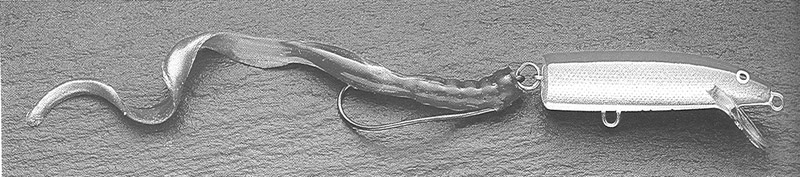
Fish such as bass, northern pike and walleye can’t resist the wile action of a jointed minnow plug, but it’s almost impossible to use these lures in weedy or bushy cover because they foul immediately. Here’s a way to make a jointed minnow more weedless while adding the enticing action of a plastic worm: 1. Remove the back end of a medium-sized jointed minnow plug by cutting or opening the rear eye; take off the front treble and split ring. 2. Twist the eye on the front section so that it is horizontal rather than vertical. Slide a split ring onto a 3/0 worm hook; then join the split ring to the plug so that the hook rides point-up. 3. Rig a 4-inch plastic worm, creature or other body on the hook Texas style. Fish the lure in pads, stumps and trees, retrieving it steadily so it swims at or neat the surface like a snake. When a fish hits, pause a second before setting the hook. |
|
|
TasunkaWitko - Chinook, Montana
Helfen, Wehren, Heilen Die Wahrheit wird euch frei machen |
|
|
|
|
TasunkaWitko
Administrator
aka The Gipper Joined: 10 June 2003 Location: Chinook Montana Status: Offline Points: 14753 |
Post Options
Thanks(0)
Quote Reply
Posted: 25 January 2006 at 07:41 |
|
Edited by TasunkaWitko |
|
|
TasunkaWitko - Chinook, Montana
Helfen, Wehren, Heilen Die Wahrheit wird euch frei machen |
|
|
|
|
TasunkaWitko
Administrator
aka The Gipper Joined: 10 June 2003 Location: Chinook Montana Status: Offline Points: 14753 |
Post Options
Thanks(0)
Quote Reply
Posted: 02 February 2006 at 06:08 |
|
8 feb 06
Edited by TasunkaWitko |
|
|
TasunkaWitko - Chinook, Montana
Helfen, Wehren, Heilen Die Wahrheit wird euch frei machen |
|
|
|
|
Post Reply
|
Page 123 4> |
 Tweet
Tweet
|
| Forum Jump | Forum Permissions You cannot post new topics in this forum You cannot reply to topics in this forum You cannot delete your posts in this forum You cannot edit your posts in this forum You cannot create polls in this forum You cannot vote in polls in this forum |


 Topic Options