|
Thank you, from the BaitShop Boyz! |
paprika hendl |
Post Reply 
|
| Author | ||||
TasunkaWitko 
Administrator 

aka The Gipper Joined: 10 June 2003 Location: Chinook Montana Status: Offline Points: 14753 |
 Post Options Post Options
 Thanks(0) Thanks(0)
 Quote Reply Quote Reply
 Topic: paprika hendl Topic: paprika hendlPosted: 16 December 2010 at 18:08 |
|||
|
this is one excellent and easy dish. the literary tie-in to bram stoker's dracula was an added bonus, and i will quote it again here:
now, i am no trained linguist or etymologist, but i do have some interest in the intersection of languages, words, history and geography. it seemed amazing to me that stoker would write of the german language being so prevalent in a region of what is now romania that seemed to me to be nowhere even close to germany. beyond that, the dish had definite hungarian influences as well, which stand out like a sore thumb (sour cream/flour sauce, beginning the dish with sauteed onions, heavy usage of paprika etc.). my suspicion was that he may have "fudged" facts a little and that he gave us a hungarian dish with a german name (since i knew that hungary has a large german minority and romania has a large hungarian minority), and simply glossed it over. i couldn't have been more wrong, however, and after quick consultation with wiki i realized the error of my ways:
this makes perfect sense and of course stoker would have known this, since any well-educated person who even traveled out of his hometown back in those days would have been familiar with the breakdown of the various ethnic groups within the austro-hungarian empire. serbians, moldavians, slovaks and other groups that seem obscure-yet-recognizable to us today would have been as familiar to him as the bohemians and moravians (czechs), polish and lithuanians - none were major groups with their own sovereign boundaries (at the time), but they all were significant minorities within a larger empire, along with wallachians, transylvanians and many more that i can't even think of at the moment.
this explained the vestigal usage of the german language as evidenced by the german hendl as well as the name for the village, klausenburgh. now, all that was left was to tie in to the hungarian cooking influences. a little more digging confirmed this, as i learned that there was a significant intersection of the hungarian populations with the german populations in - you guessed it - transylvania.
on the map below, note the location of transylvania (home of the "transylvanian saxons") and the location of the western portion of the carpathian mountains (separate from the eastern chain that runs south and curves to the west):
 also, note that the modern, romanian name for klausenburgh is cluj-napoca (right above the second A in transylvania), and it is in fact the capital of the province of transylvania in romania. much information on the hungarian connection to klausenburgh/cluj-napoca from wiki can be found by clicking the embedded link in the modern name
on the map below, the same location is in very close proximity to the small pokets of hungarian minority populations (in green). in fact, the location of cluj-napoca is, as far as i can tell, right smack in one of the green pockets.
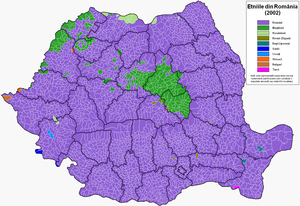 it was beginning to gel for me, and consultation of the linguistic demographics of romania made it clear:
it was here that the lightbulb came on and i realized what i should have known all along: that transylvania in stoker's time was associated with hungary and not with romania, which didn't incorporate transylvania until after world war one.
it all fit beautifully - at least, it fit close enough so that i was convinced of its plausibility. stoker knew his stuff and i happily acknowledged that i had been schooled. this is a true balkan dish, with hungarian origins, and the german name of the dish is a result of the fact that it was prepared by descendents of transylvanian saxons; said dish was eaten by traveling guests who were looking out the window of a hotel (located in a town with german and hungarian origins) at the carpathian mountains in what is now the romanian province of transylvania.
i should have thought of this, since the town where my wife's family emigrated from (zakarovce) was also part of the hungarian empire and was thought of as hungarian, even though it is now in slovakia.
so, set straight and inspired, i decided to give this a go, using john's recipe to the letter:
this one was a pleasure to make, and was enjoyed by all. it definitely will be made again and i encourage any interested person to try it, for you will not be disappointed! here's how it went down: due to circumstances, i didn't get a shot of the goods, or of the rendering of the chicken fat (after removing the skins from the 8 thighs and 6 legs that we used for this meal), which is what i chose to use rather than butter or olive oil for carmelizing the onions etc. when i make this again, i will be sure to get shots of those steps.
basically, i removed the skins from the chicken pieces; then, i began heating the chicken skins in the dutch oven over medium heat, until they gave up all of the rich, flavorful fat that they had to offer and became dark (not burned) and crispy. this takes a little time, and you want to make sure that the fat does not begin to burn. after removing these "cracklings," i spooned out all but about 4 or 5 tablespoons of fat (this turned out to be too much left in the dutch oven - i should have removed all but 2 or 3) and began heating the onions in the rendered fat.
alternately, i could have kept the skins on and rendered the fat from the chicken pieces as they browned, but i wanted to leave the skins out of the final dish, hence the removal and rendering of the skins. this step, whether with pork, poultry or any other rendered animal fat, is a hallmark of hungarian cooking. you can skip this step if you like and use butter, olive oil or even canola oil, if you want, but you will miss out on some of the subtle joys of this dish, and also a nice, deep layer of goodness. this was the first time i had ever rendered fat from chicken for cooking; it was quite easy and while i am sure it is not nearly as healthy as canola oil, the depth of flavour was amazing.
here we are with the onions sweating out in the hot dutch oven:
 i read somewhere that in hungarian cooking, the onions are slowly sautéed just to the point where they are on the verge of turning brown, which was just about here:a couple-three minutes later, i removed the dutch oven from the heat (this is important, so as not to scorch the garlic and paprika) and added the garlic cloves (which i had forgotten to leave whole and ended up chopping) as well as the salt and pepper:
 it was here that i decided that i probably retained a little too much fat in the dutch oven after rendering, and made a note to use less next time.
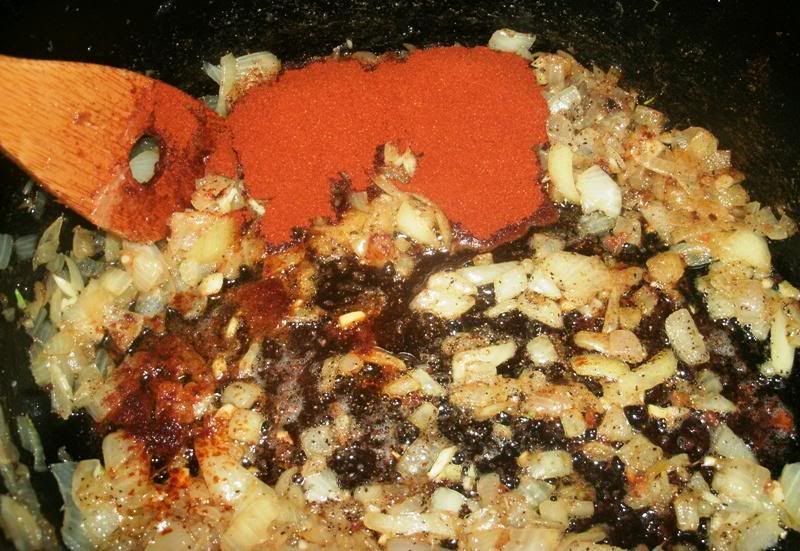
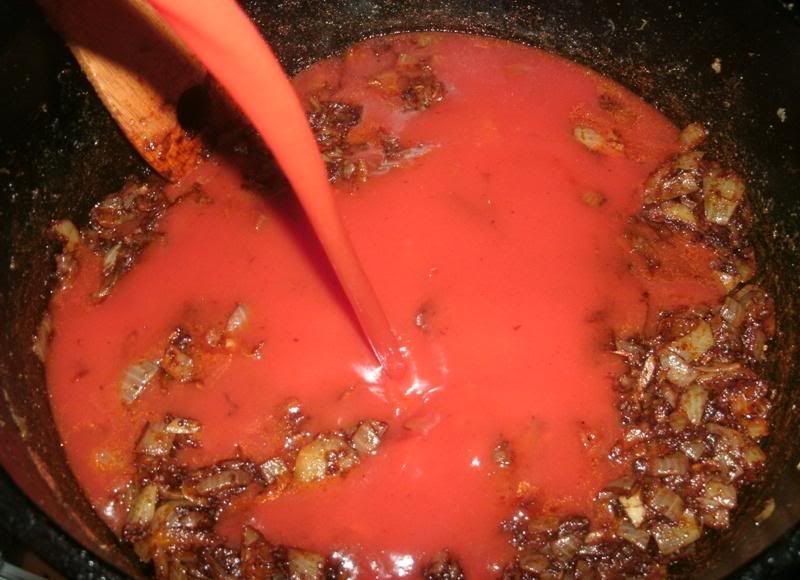
i then added half the paprika, stirring to mix well, then added the v8 juice:
 you might be thinking, where did one find v8 juice in 19th-century klausenburgh? i wondered that myself, until i realized that v8 is simply tomatoes, which would have been available at any market or garden, and vegetable stock, which would have been the base of many, many dishes (including this one, presumably), especially once combined with the juices of the chicken to make what is essentially a tomato-infused chicken stock - quite plausible.
using the v8 juice as a de-glazing liquid, i returned the dutch oven to the heat and scraped the brown bits of chicken (left over from the rendering) off the bottom. when everything was stirred well, i added the chicken thighs and legs, and then reduced the heat to the lowest setting for simmering.
here's how everything looked just as i was putting the heavy lid of the dutch oven down:
 and after an hour of simmering to cook the chicken pieces, here's the first thing we saw when we lifted the lid:
 after carefully removing all of the chicken thighs and legs:
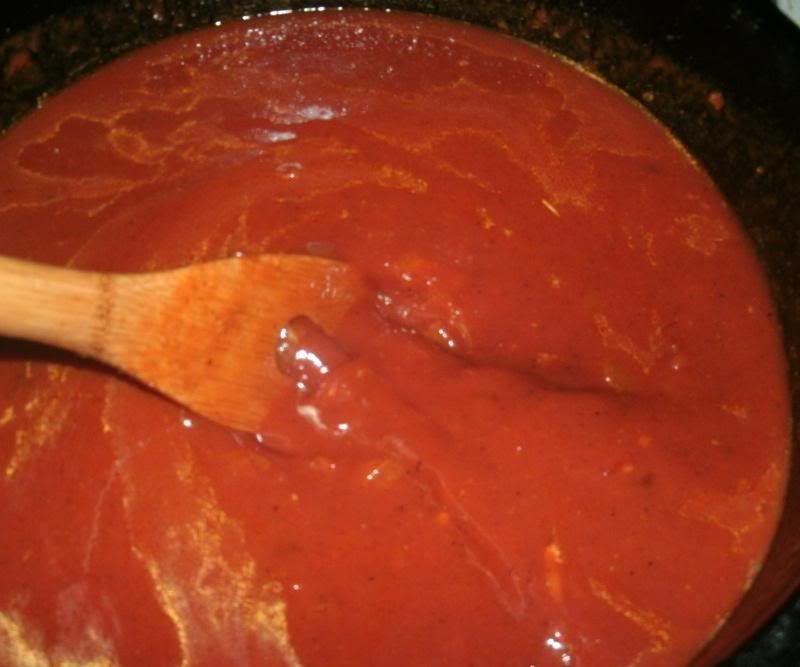
 we took a look at the wonderful, rich sauce that was forming.:
 it was a true treasure, but this is hungarian cooking, so there was another step that would ensure a creamy richness to this dish.
after stirring the flour into the sour cream (this is a really bad picture, but it was the best i had):
 we folded the sour cream and flour into the sauce. i immediately realized that i should have mixed the flour in more thoroughly, perhaps with a wire whisk:
 but before long the sour cream melted into creamy richness and the flour incorporated itself into the sauce just fine.
i then added the remaining paprika (which could just as easily have been added and incorporated to the sour cream/flour mixture):
 and returned the chicken pieces to the dutch oven:
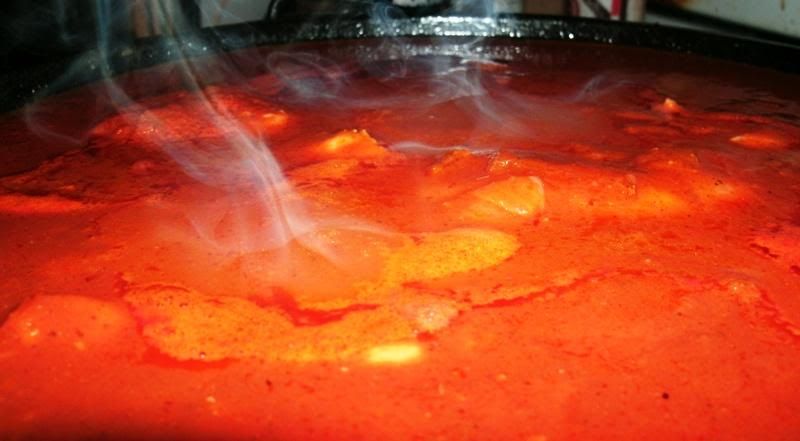
 the picture does not quite do justice to the wonderful, old-world goodness that was bubbling in that pot. the flash brightens the sauce far too much, and the chicken was sinking to the bottom, making it hard to look as good as it really was - but no matter, because the smells were making up for it.
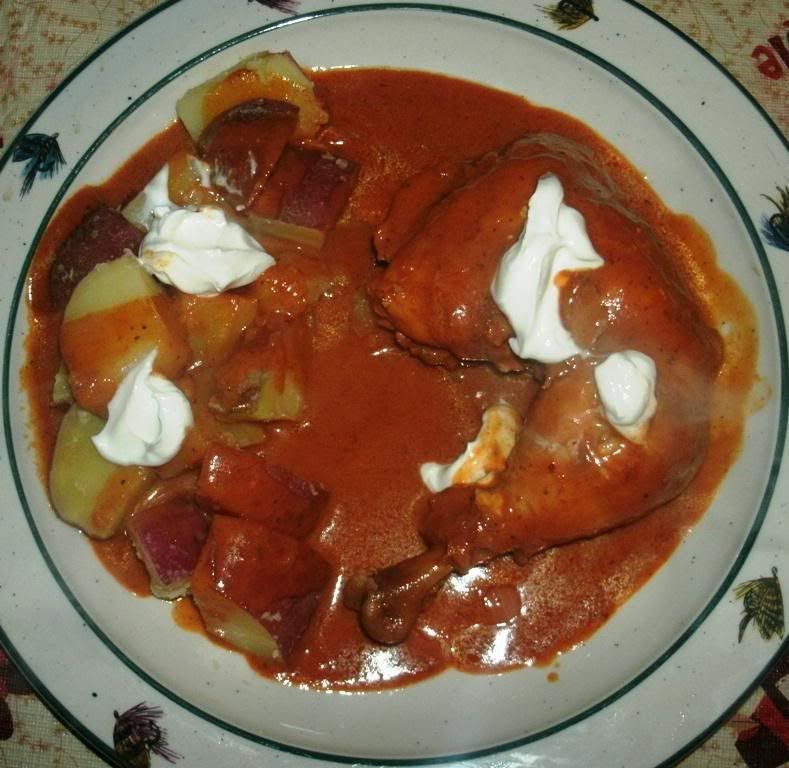
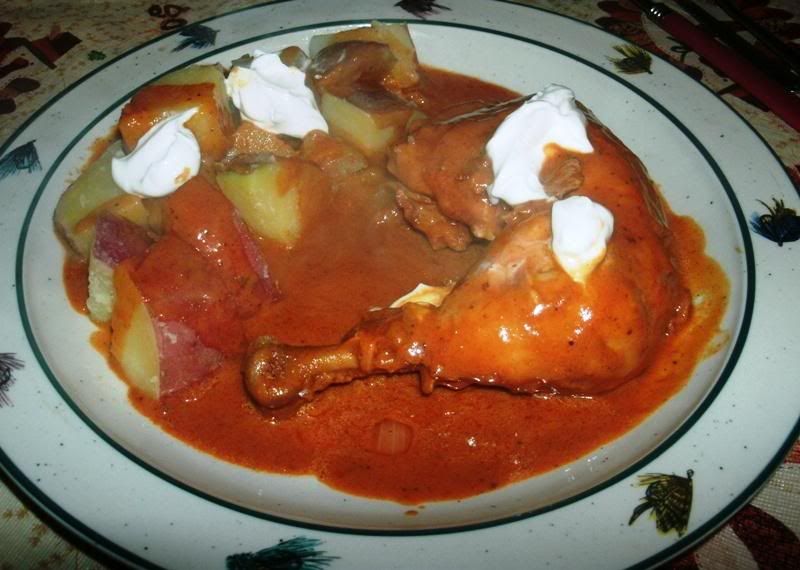
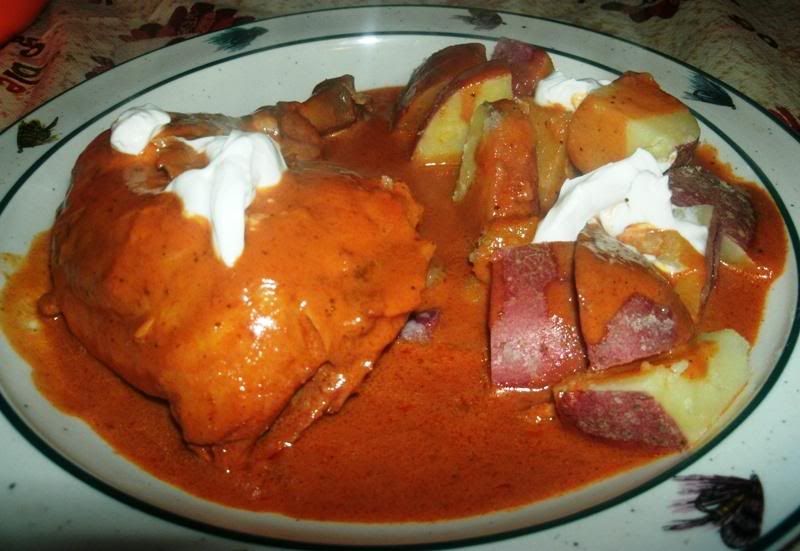
after 5 or 10 minutes of simmering, we prepared the plates and served the meal with mashed potatoes. this is my favourite of the plated pictures, because it shows just how dark, warm and savory the sauce was:
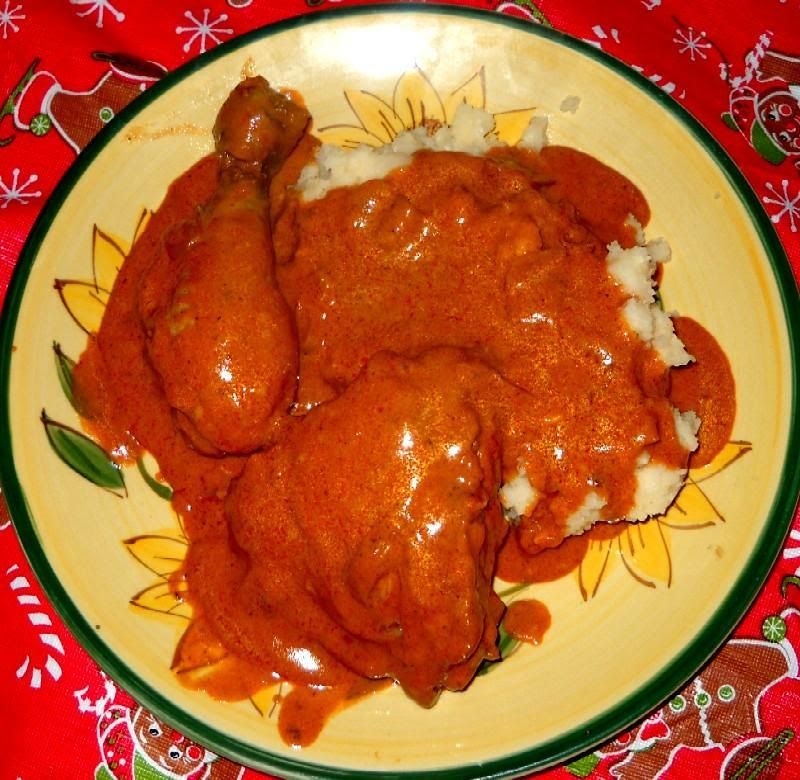 as i said before, too many times the flash would wash this deep richness out:
 but no worries, this one was a definite keeper!
i served this to the beautiful mrs. tas, who actually enjoyed it, to my pleasure and surprise, and also to our four children, who all were pretty enthusiastic about it and had no complaints. also, two friends of the boys were over and they also enjoyed this meal. it seems that whenever i am cooking, they show up for supper, which is alright.
 the two big mistakes i encountered while making this were that i did not remove more chicken fat after rendering, and that i did not mix the sour cream/flour mixture better before adding to the pot. neither of these errors hurt the dish; however, correcting them will certainly result in a better experience next time.
in all, this was definitely a do-again meal and a complete success, reaching back a hundred-and-fifty years or so into the dark hollows of the carpathians and the fascinating heritage that is a mixture of german, transylvanian and hungarian traditions. i would encourage anyone who wants to appreciate true old-world dining to give this simple meal a try. Edited by TasunkaWitko |
||||
|
TasunkaWitko - Chinook, Montana
 Helfen, Wehren, Heilen Die Wahrheit wird euch frei machen |
||||
 |
||||
|
JUSTN A. MURKAN
.243 Winchester 

Joined: 21 September 2010 Location: United States Status: Offline Points: 134 |
Post Options
Thanks(0)
Quote Reply
Posted: 11 January 2011 at 12:08 |
|||
|
who in hell wants to eat messkin when you can have German/Russian/eastern Euro grub !!!!!!!!!

|
||||
|
If,,in the end all I have is my honor......it will be enough!
|
||||
|
||||
|
TCLouis
.223 Remington 

Joined: 11 December 2005 Location: United States Status: Offline Points: 65 |
Post Options
Thanks(0)
Quote Reply
Posted: 13 January 2011 at 16:13 |
|||
|
Fixed this one last week and served over egg noodles.
That was GOOD EATS. Did not have sweet paprika, only "regular" and it was still good. I plan to get some sweet paprika and see if it is any different/better. Edited by TCLouis |
||||
|
There is Family, Huntin, Fishin, Outdoors, . . .
The rest is pretty much frittering ones life away |
||||
|
||||
|
TasunkaWitko
Administrator
aka The Gipper Joined: 10 June 2003 Location: Chinook Montana Status: Offline Points: 14753 |
Post Options
Thanks(0)
Quote Reply
Posted: 14 January 2011 at 01:58 |
|||
|
glad you liked it! one thing about it is that it is so easy and uses such common ingredients there is no reason NOT to try it! |
||||
|
||||
|
TasunkaWitko
Administrator
aka The Gipper Joined: 10 June 2003 Location: Chinook Montana Status: Offline Points: 14753 |
Post Options
Thanks(0)
Quote Reply
Posted: 07 October 2011 at 07:01 |
|||
|
In the spirit of Halloween, I invite everyone to make this dish for supper on or around October 31st ~ click this link: http://foodsoftheworld.activeb...anian_topic1001.html for the literary and cultural history of this dish as well as the recipe and step-by-step pictures of the preparation - also, be sure to invite any of your foodie friends who might be interested! hope to see some pictures of everyone's dinner party! ron |
||||
|
TasunkaWitko - Chinook, Montana
Helfen, Wehren, Heilen Die Wahrheit wird euch frei machen |
||||
|
||||
|
TasunkaWitko
Administrator
aka The Gipper Joined: 10 June 2003 Location: Chinook Montana Status: Offline Points: 14753 |
Post Options
Thanks(0)
Quote Reply
Posted: 14 December 2011 at 07:08 |
|||
|
Here's how my 2011 paprika hendl went down ~ I apologize for taking so long, but it's been quite a couple of months, and unfortunately, things don't look any less-busy in the near future! I hope that the wait was worth it, as I think I’ve got a pretty good run-down here, and some of these pictures are going to end up as part of the original tutorial, as well. Here a shot of the goods needed, except for the chicken (and of course, the fat rendered from the chicken) - all prepped and ready:
I used a 10-pound bag of leg quarters, which, if I remember correctly amounted to 12 or 14 quarters total. Amazingly, these all fit into my Dutch oven, and were enough for everyone who was at the house that night, with a couple of leftovers for lunch the next day. Worthy of note is that the paprika I used was the "cheap" variety, yet seemed to yield better, smoother and more flavourful results than a more expensive kind I have used before. My caveat to this observation is that I have not yet used the really "good," authentic stuff, so take it for what it's worth - however, my advice is, unless you go for the "premium" Hungarian paprikas, you might as well find a cheap one that you like and stick with it. Another note - you can make this with tomato juice of course, but my strong advice is to use V8-style juice, which may seem like an historical anachronism until you remember that the only real difference between V8 juice and tomato juice is a "broth" of mixed vegetables - and vegetable broth would have been a ready and available base for cooking back in the day. If using skinned chicken, you do not want to pre-brown it; just set the pieces aside and start rendering the fat from the skin. However, if you choose not to skin your chicken, then begin the dish by browning the pieces in batches to render the fat and set the pieces aside until after you add the V8 juice. Here we are, rendering the chicken fat from the skin:
You want to do this at a fairly moderate heat - it's better for the heat to be a little too low, rather than too high, so that you can render the fat without burning the skin, which would ruin a lot of good flavour. Also, some people like to reserve the "cracklings" from the skin when rendering is complete, and serve them as a garnish or as a special treat of their own. This can't be done if the skin is burnt, of course. I chose not to do reservev the cracklings, but did give a few to the pets, and they seemed to like them. As you can see from this picture, quite a bit of fat is rendered from the skin:
I added back a few tablespoons to the Dutch oven:
And got busy carmelising the onions. The brown bits on the bottom of the pan added a lot of colour and flavour to the party, as you can see:
This is another step that you want to do rather slowly over moderate heat; the idea is to get the onions just to the point where they release their sugars and add a rich depth and subtle sweetness to a dish. Usually, it is a moment or two before they start to turn brown; consequently, it takes a little bit of experience to judge how much cooking of the onions is enough. In Hungary, great pride is taken in slow-carmelisation of onions as the foundation of a good meal, and it is one of the things that will make your Hungarian dining experience a truly authentic one. Once the onions are where you think they should be, add the garlic and cook for just a minute or two in order to start the releasing of that wonderful flavour. Then remove the Dutch oven from the heat and add your paprika:
You do not want to do this over direct heat, or the paprika could scorch and will probably turn gritty as well. The dish probably won't be ruined, but it certainly won't be as good as it can be. After stirring a few minutes in order to allow the paprika to release its oils and darken, I added most of the V8 juice, reserving some so that I could thin out the sauce later, if necessary:
Then I stirred everything around before returning the Dutch oven to the heat:
Given the subject matter, both historical and literary, I must say that this is a most appropriate dish. As we all know, Bram Stoker's sinister title character was based on historical nobles, including Vlad III, the Impaler of Wallachia:
And Countess Erzsébet Báthory de Ecsed of Hungary, who literally bathed in human blood:
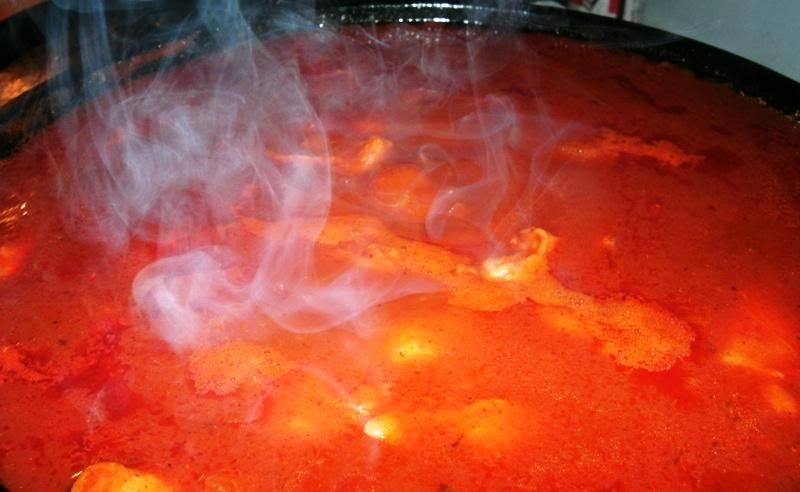
This rich, thick, blood-red historic dish certainly sets the mood ~ After returning the Dutch oven to the heat, I added the chicken leg quarters and slowly brought everything to the beginnings of a boil. As you can see, the recipe as written will just accommodate 10 pounds of skinned leg quarters, filling the Dutch oven to the brim:
Here’s another picture that, to me, captured the sinister back story of the dish:
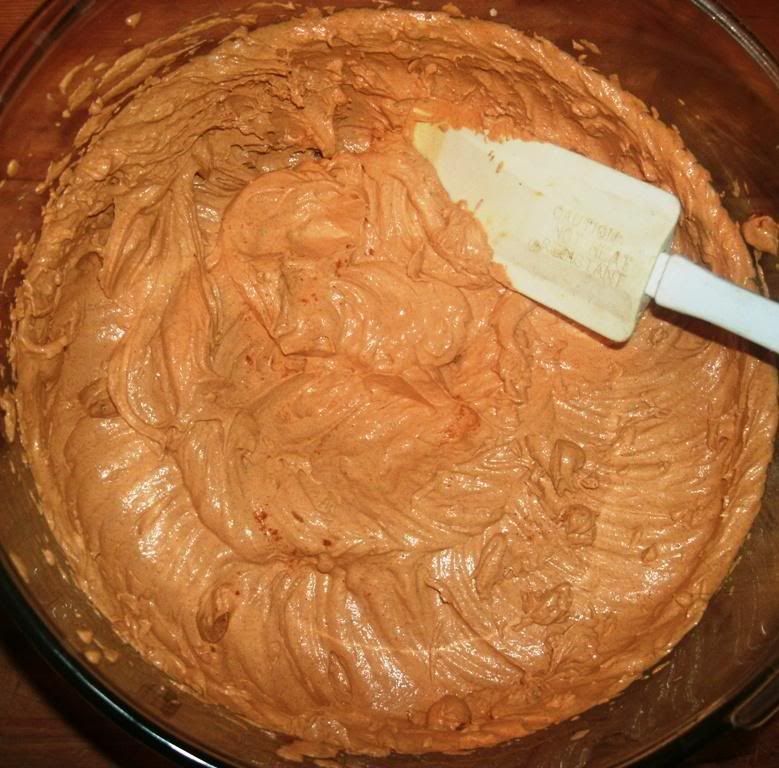
And on Halloween, no less! When the Dutch oven came to a boil, I reduced the heat low enough to maintain a slow simmer, then covered the chicken so that it could cook for about an hour. The amount of time gives or takes by about 15 minutes, depending on how much chicken you use and other factors. The chicken will be done when you can pierce a thick part of a thigh with the tip of a knife and the juices run clear. Toward the end of the simmering, I prepared the sour cream and flour mixture; I chose to add the remaining paprika at the same time, making it look pretty cool:
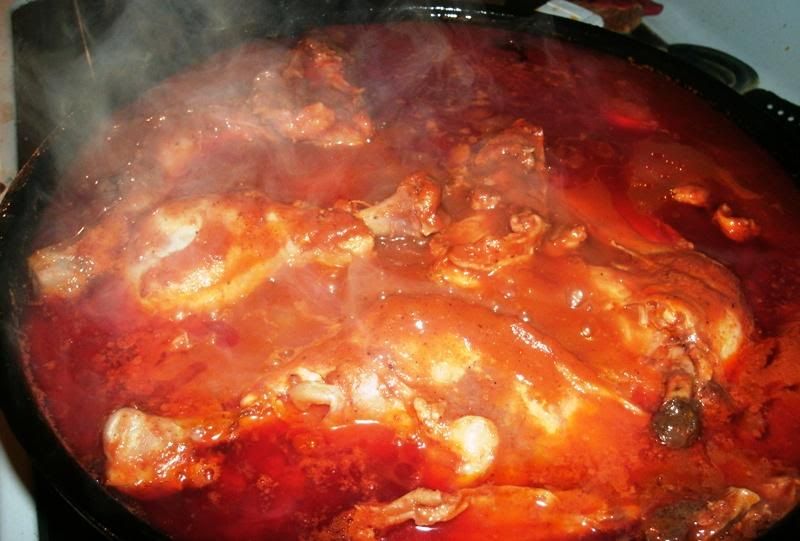
The purpose of the flour and sour cream is two-fold: first, the sour cream tones down the paprika, keeping it from overpowering the dish, yet allowing its bold flavours to come through; secondly, this step thickens the sauce into a beautiful, thick, rich gravy for topping your chicken and your side dishes, whether they are potatoes, vegetables, dumplings, noodles or what have you. Here’s our bubbling cauldron, with the chicken done and dish ready for the final stages:
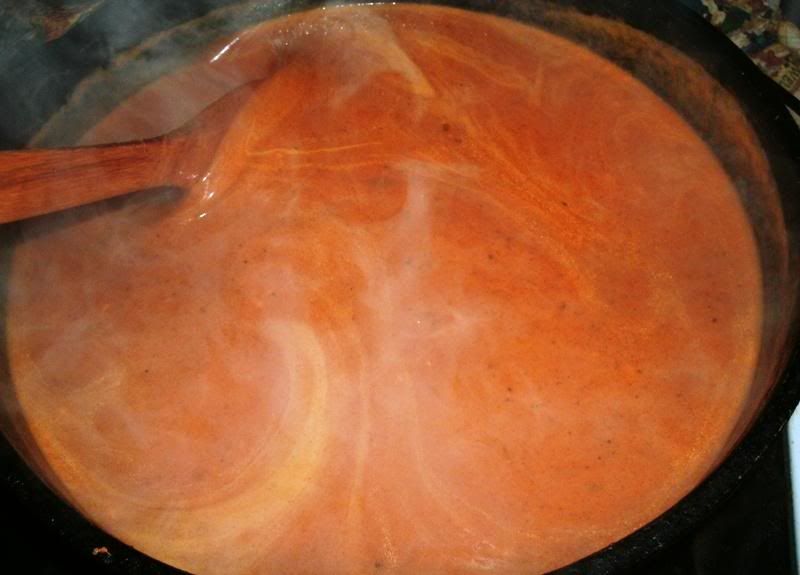
I removed the chicken and added the flour/sour cream/paprika mixture, stirring until the sour cream melted into the sauce for a beautiful, rich gravy:
As I let this simmer a few minutes longer, the flour and the additional paprika cooked into the sauce, darkening it beautifully and giving one last layer of flavour. I then added the chicken pieces back to the Dutch oven in order to coat them well with the sauce, and served this truly historic dish with simple, boiled potatoes, topping with a few dots of sour cream: As always, this savory, historic dish was a crowd pleaser that the entire family enjoyed, and I think it could have been my best preparation yet. I added some of the V8 juice back into the sauce - but must have used a little too much, since it was thinner than last time, but no worries - it worked very well.
This was a perfect meal to enjoy as we watched Monday Night Football and handed out treats to young trick-or-treaters who were out on this crisp autumn evening; but the truth is that you don't need to wait for Halloween to try this - while it is perfectly suited for fall and winter cooking, it is great any time of year!
Thanks for looking, and especially to all who took part in Dracula’s 2011 Paprika Hendl Dinner Party. I do hope that this becomes an annual tradition for those who participated, and that others will be inspired to give it a try next year, after seeing how easy it is. If anyone has any questions at all, please let me know! Edited by TasunkaWitko |
||||
|
TasunkaWitko - Chinook, Montana
Helfen, Wehren, Heilen Die Wahrheit wird euch frei machen |
||||
|
||||
|
Post Reply
|
|
 Tweet
Tweet
|
| Forum Jump | Forum Permissions You cannot post new topics in this forum You cannot reply to topics in this forum You cannot delete your posts in this forum You cannot edit your posts in this forum You cannot create polls in this forum You cannot vote in polls in this forum |


 Topic Options
 "We left in pretty good time, and came after nightfall to Klausenburgh. Here I stopped for the night at the Hotel Royale. I had for dinner, or rather supper, a chicken done up some way with red pepper, which was very good but thirsty. (mem. get recipe for Mina.) I asked the waiter, and he said it was called "paprika hendl" and that, as it was a national dish, I should be able to get it anywhere along the Carpathians. I found my smattering of German very useful here; indeed, I don't know how I should be able to get on without it."