
|
Thank you, from the BaitShop Boyz! |
Canning Whole/Halved/Quartered Tomatoes |
Post Reply 
|
| Author | |
TasunkaWitko 
Administrator 

aka The Gipper Joined: 10 June 2003 Location: Chinook Montana Status: Offline Points: 14753 |
 Post Options Post Options
 Thanks(0) Thanks(0)
 Quote Reply Quote Reply
 Topic: Canning Whole/Halved/Quartered Tomatoes Topic: Canning Whole/Halved/Quartered TomatoesPosted: 27 October 2011 at 07:15 |
|
As I have said so many times, the best foods come from the land, and it shows in every "peasant" or "rustic" dish. The foods that I remember most fondly, and the dishes that are most enjoyed by the beautiful Mrs. Tas, are the ones that come from the most basic and honest origins. I believe that modern, even "hi-tech" methods of cooking definitely have their place and are to be revered for what they are - but my favourites, the ones that I always go back to, come almost straight from the land and would be recognizable to "the common people" going back a hundred years, sometimes even longer. There is something that is absolutely honest and satisfying in eating a meal that has never seen a processing plant, let alone the inside of a can or a box. Food such as that, in my mind, carries its own credentials and is a true masterpiece, no matter how humble or unadorned it may appear in presentation. The same holds true when it comes to preserving the simple, good things from the earth, a tradition born out of the necessity of having food stored over for winter. Beginning with the German and Slovak peasant ancestors in the ancestry of our own family - who surely engaged in activities such as drying fruits, fermenting cabbage and making sausages - and extending to the backyard gardens that our grandparents tended and harvested in the tiny, rural communities that their own parents settled, Mrs Tas and I share an appreciation and affection for the childhood memories of going to the pantry and seeing the jars of home-canned goods lined along the shelves in their multi-coloured glory, waiting to be opened and used in some good, comforting thing that Grandma was cooking for supper as the snow fell gently outside the kitchen window as a grey winter day darkened in anticipation of the approaching evening - and the supper we would enjoy around the family table. One of the most basic foods that can be canned is the tomato, and preserved in its simplest and most versatile form - whole - it can be used in a myriad of entrees, condiments and other creations. Our garden didn't do so well this year, mostly due to an extremely late planting due to weather; however, I did retrieve enough tomaotes to can a few jars last weekend, while out at my parents' house.
For review, here is some useful, fundamental information on canning tomatoes from http://www.canning-food-recipes.com, which will allow you to familiarize yourself with some "ground rules" of canning tomatoes:
Here's how things went down when I tried this with some help from my mother. I won't even guess at the specific amount of tomatoes that I had for this session, but it was adequate for exactly eight quart-sized jars, plus one quart of fresh, home-grown tomato juice.
Other than the tomatoes and jars, here's all you need:
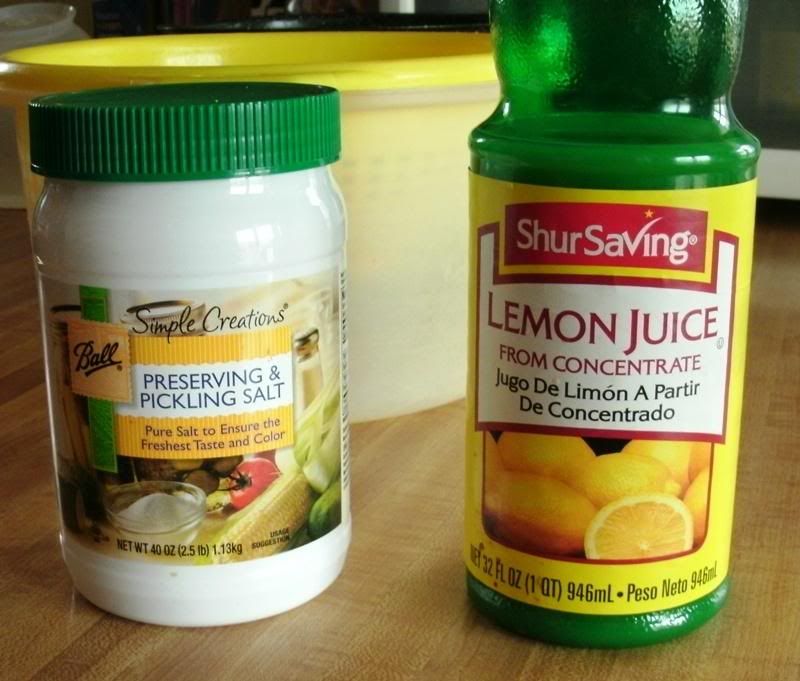 In truth, some would argue that you don't even need the lemon juice, or salt, for that matter. Some will say that the tomatoes contain plenty of acid for safe canning, and that the salt is simlpy for flavour and can be omitted for personal preference or health reasons. I am sure that the opinions on salt are valid, but I add it anyway for taste preferences. As for the lemon juice, many sources recommend 2 tablespoons of bottled lemon juice per quart to ensure that there is enough acid for safe preparation. I've noticed that tomatoes canned with a little bit of lemon juice have a bright freshness as well, so I prefer to use it. Having said that, you can read the information yourself and decide if you want salt and/or lemon juice with your canned tomatoes.
The first step is to wash the tomatoes, then peel/skin them. This is accomplished by dipping them, in batches of a few at a time, in a pot of simmering water for about 45 seconds, or until it is visually obvious that they are starting to lose their skins:
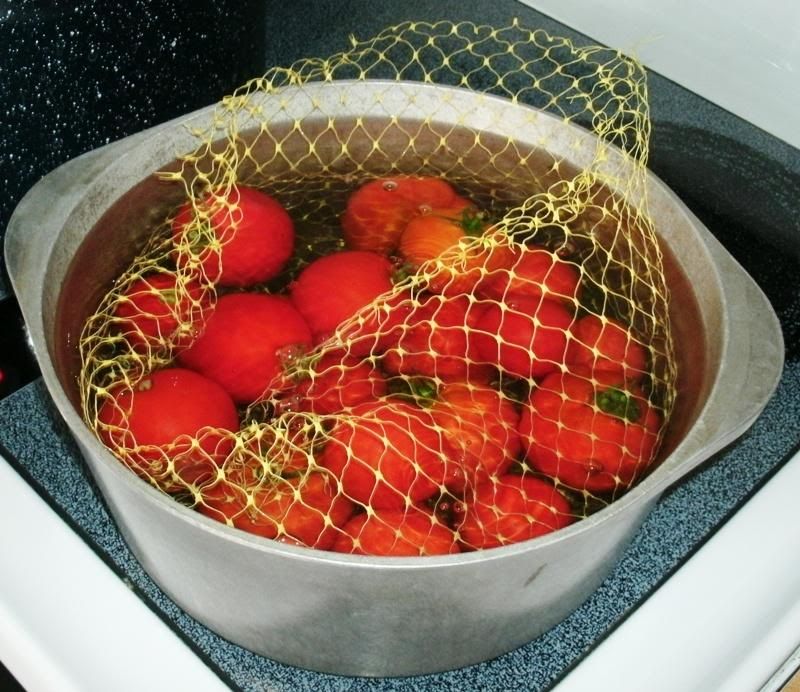 An onion bag works great for this, so that you are able to dip them in and lift them out easily.
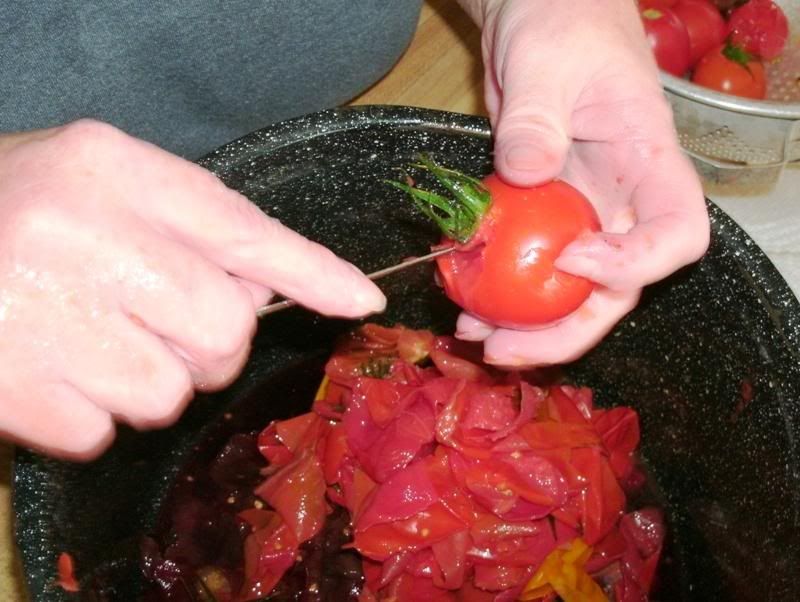
Some people like to cut a small X iinto the bottom of the tomato before dipping, in order to facilitate peeling afterwards. You can if you want, but I haven't really found it to be necessary. After dipping, remove them from the water and shock the by dipping in cold wayer for a few seconds. Then, one at a time, cut off the stems and remove the cores:
 and peel off the skins:
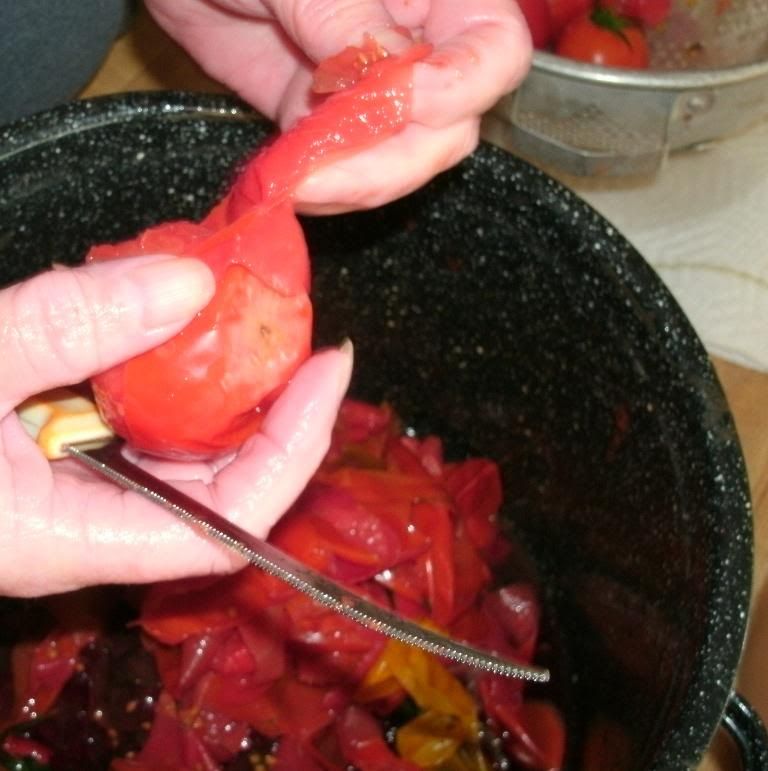 You also want to remove any blemishes or dark spots.
Note the knife; my mother says that this type of "tomato knife" is the best tool to use for the job. In fact, she didn't even want me to help with this because she only had one tomato knife and said that she had learned from experience that it takes too long with any other type of knife. Who's going to argue with Mom?
After peeling them, drop them into a container:
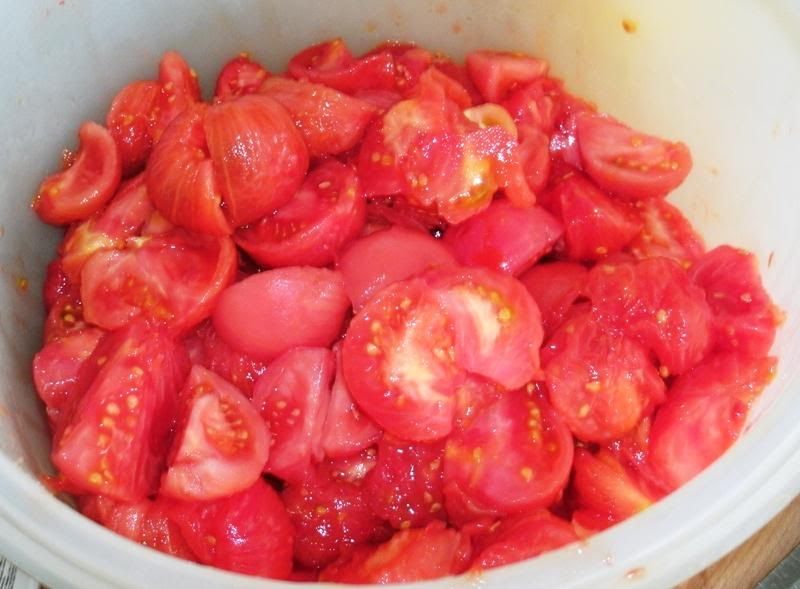 Depending on their size - and to some extent, your preferences - you will want to leave them whole or possibly cut them into halves or quarters.
To pack the tomatoes into jars, have everything ready, including clean jars simmering in the canning kettle, clean lids and bands waiting in a bowl or pan of hot water, a clean, hot, wrung-out cloth standing by to wipe the rims of the jars and so on.
A wide-mouthed funnel helps with packing:
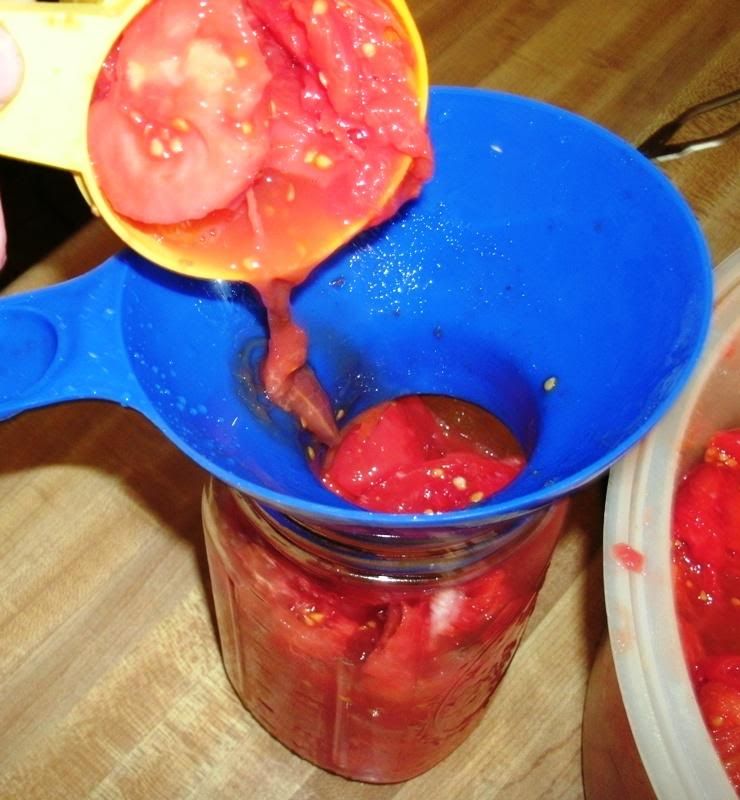 Don't be shy about pressing down on the tomatoes and packing them tightly; it seems to work best that way. The tomatoes will make their own juice, so it is not necessary to add any water, although you may certainly do so if you prefer. Be sure that you leave a 1/2-inch headspace
NOTE: Tomatoes packed with water will have a differend processing time versus tomatoes packed in their own juice.
These next two steps, you can do EITHER before OR after packing the jars. I prefer to do them before, but did them after packing here for demonstration purposes. First, one teaspoon of salt per quart:
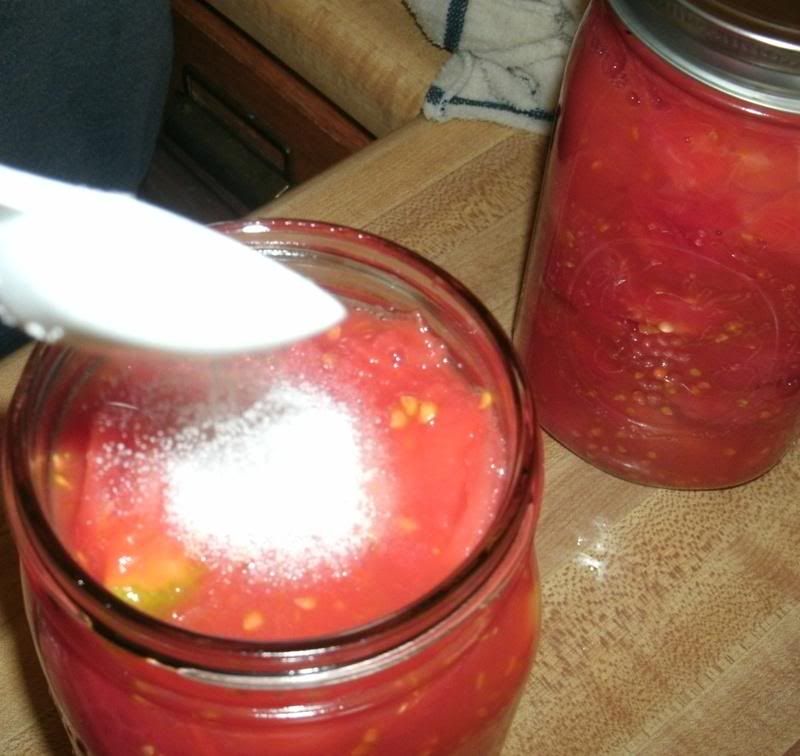 Some sources say 1/2 teaspoon per quart, others say 1 teaspoon. Still other sources say you don't have to add salt at all. I added a teaspoon; you can add what you think is right.
Next, you can also add (bottled) lemon juice:
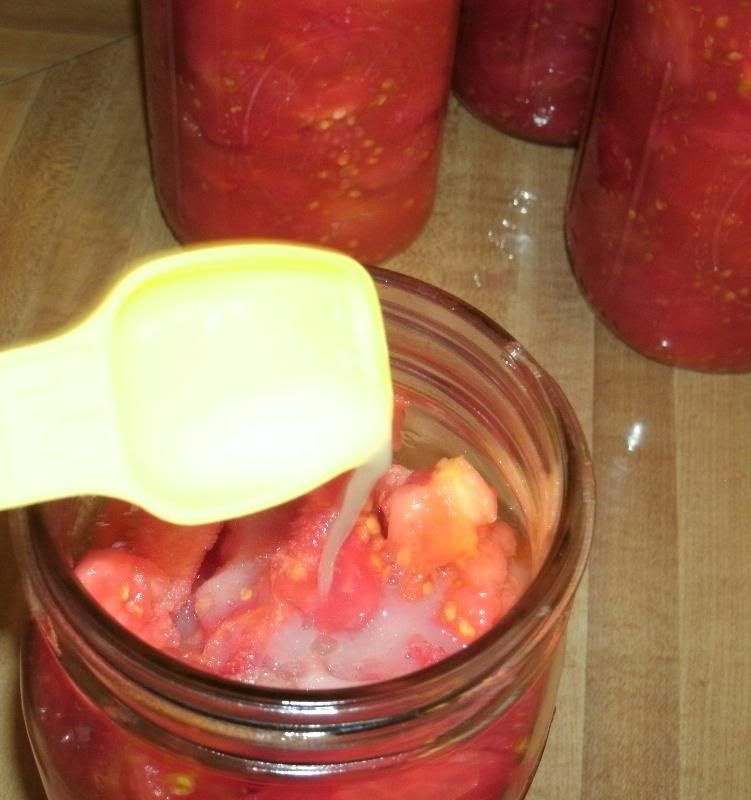 My mother had never heard of this step, which some people perform for the reasons stated above. Most references I read recommend adding two tablespoons of lemon juice per quart. My mother was skeptical, so I met her in the middle and added 1 tablespoon per quart jar.
NOTE: The literature I have read says to use BOTTLED, not fresh lemon juice. I have no idea why, but since fresh is specifically excluded, I assume there is a reason for this.
Here are the tomatoes going into the canner:
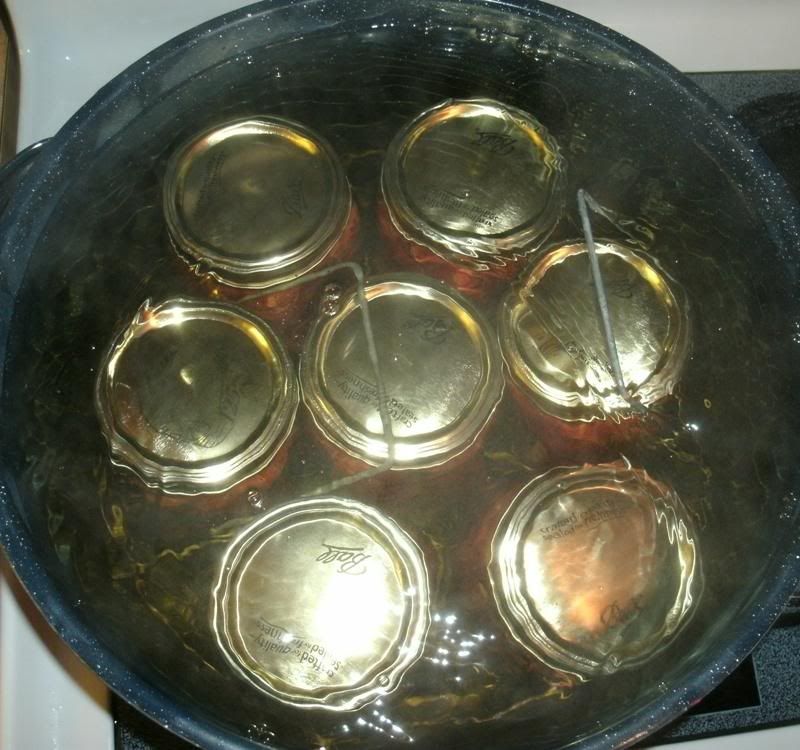 The water should be simmering just below a boil now. Increase heat to bring to a boil and cover the kettle.
Once the water is at a rolling boil, begin the timing for processing. For tomatoes packed in water, the base line for processing quarts is 45 minutes; For tomatoes packed in their own juice, the base line for processing quarts is 85 minutes (one hour and 25 minutes). For our altitude, we added 5 minutes to the processing time.
Once the processing time had passed, we removed the jars to a draft-free place to cool on a towel:
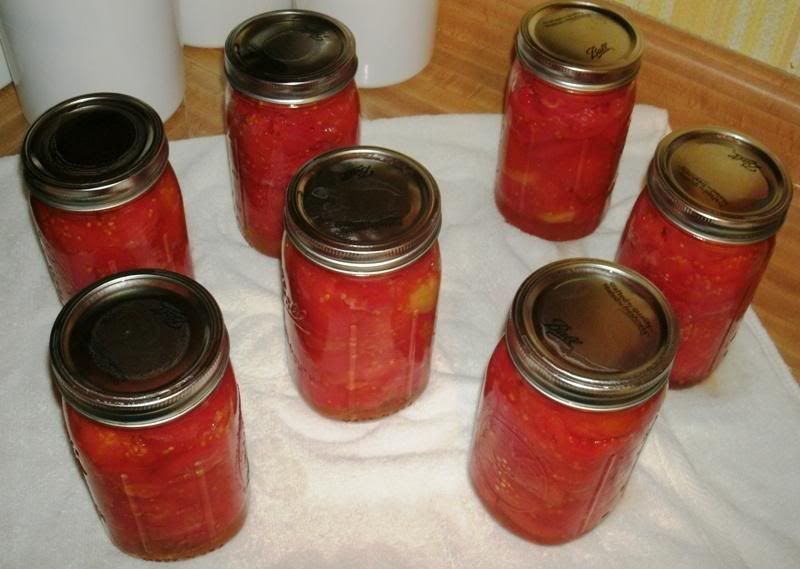 As you can see, we grew a few yellow tomatoes, too!
The canning kettle held seven quarts; this batch filed eight quarts; also we had a quart of juice left over which we put in a quart jar with the last three or four tomato quarters (right):
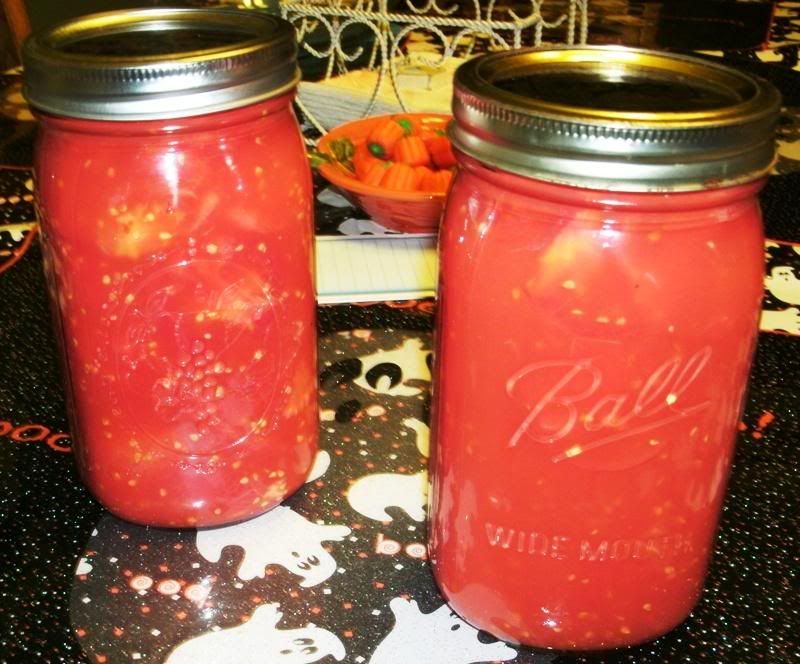 We didn't process these two "extra" jars, so I simply put them in the refrigerator and used them over the course of this last week.
So with a little bit of time and effort, we managed to secure a wonderful, nutritious, home-grown base for at least eight delicious meals. Not too bad, considering that the monetary investment was almost nothing!
Thanks for looking and I hope this helps someone who wants to give this a try for themselves. If anyone has any questions, please ask! Edited by TasunkaWitko |
|
|
TasunkaWitko - Chinook, Montana
 Helfen, Wehren, Heilen Die Wahrheit wird euch frei machen |
|
 |
|
|
mule_tail
.243 Winchester 
Joined: 14 December 2003 Location: United States Status: Offline Points: 118 |
Post Options
Thanks(0)
Quote Reply
Posted: 07 November 2011 at 13:35 |
|
you did that at grandmas house
|
|
|
mike
Chinook, Montana im not a hunter, im a wildlife population control specialist. |
|
|
|
|
TasunkaWitko
Administrator
aka The Gipper Joined: 10 June 2003 Location: Chinook Montana Status: Offline Points: 14753 |
Post Options
Thanks(0)
Quote Reply
Posted: 07 November 2011 at 14:11 |
|
yep -i figured trying to do it at home would be a disaster!
|
|
|
TasunkaWitko - Chinook, Montana
Helfen, Wehren, Heilen Die Wahrheit wird euch frei machen |
|
|
|
|
Post Reply
|
|
 Tweet
Tweet
|
| Forum Jump | Forum Permissions You cannot post new topics in this forum You cannot reply to topics in this forum You cannot delete your posts in this forum You cannot edit your posts in this forum You cannot create polls in this forum You cannot vote in polls in this forum |


 Topic Options
 Traditionally, canning tomatoes has usually been done by using the hot water bath canner method....